

The DOJ dropped the largest batch of the Epstein Files yet this week, and they revealed just how many things the notorious pedophile had his tentacles in – and that includes Bitcoin.
Social media was awash with references to prominent Bitcoiners who were either mentioned in Epstein’s emails, took funding from the sex-offender financier, and/or had direct contact with him over the internet or in person.
To get it out of the way: none of these emails necessarily prove any illegal acts by the people mentioned in this article, nor do they implicate them in any nefarious behavior. Further, Epstein’s ties to Bitcoin do not mean that he – or the Depp State! – created or co-opted Bitcoin. Jeffrey Epstein may be a nonce, but that doesn’t mean he has anything to do with Bitcoin’s nonces.
That said, the emails do show that Epstein invested in early stage Bitcoin companies, and he was in contact with some of the more impactful personas of Bitcoin’s early days.
Why is anyone’s guess, but it probably has a lot to do with Epstein’s attempts to exert influence over anyone and anything of consequence when he was running around unchecked, which includes bleeding edge, far-out new technology.
And with that out of the way, let’s dive into our findings.
Brock Pierce is all over the Epstein Files
Brock Pierce? The former child actor, Mighty Ducks star, and EOS cofounder?
Yes, that Brock Pierce.
The serial crypto entrepreneur and generally-creepy-dude first made contact with Jeffrey Epstein in 2010 by way of Al Seckel, the late illusionist and paramour of Isabel Maxwell, who is the sister of Jeffrey Epstein’s lover-in-chief, Ghislaine Maxwell.
In 2010, Seckel organized the so-called Mindshift Conference on Epstein’s Little Saint James island. The conference was one piece of a public relations push to repair Jeffrey Epstein’s reputation following his 2008 conviction in Florida for sexually trafficking a child and soliciting prostitution.
It was a total dud, so much so that Epstein penned a fake email to Seckel, pretending to relay message from an Epstein Foundation member. But Epstein got his first Bitcoin connection out of it: Brock Pierce, who spoke at the event.
Pierce and Epstein maintained a relationship up until Epstein’s death in 2019. During this time, Pierce enjoyed assignations with some of Epstein’s “girls,” took legal advice from Epstein on how to resolve 5 years of tax evasion, introduced Epstein to Steve Bannon, and served as Epstein’s point of contact for personalities in the Bitcoin space, including the Winklevosses.
(If you want a more thorough rundown of the more salacious and dastardly side of Pierce and Epstein’s relationship, I recommend this article on Protos, which covers some of the above in depth; for our purposes, we’ll be more focused on the nexus of Pierce and Epstein’s business relationship and their investments in Bitcoin companies).
A few more bits of interesting trivia unearthed by the Epstein files before we get to the meat of it: Pierce tried to purchase Mt. Gox in May 2013, nine months before it collapsed; and in 2014, Pierce also wanted to tap Larry Summers to “get involved” with USDT issuer Tether – which Brock cofounded in 2014 – perhaps to give legitimacy to the project.
Epstein invested in Coinbase via Pierce’s Blockchain Capital
But most notably, Epstein used Brock Pierce’s Blockchain Capital as a surrogate to invest in Coinbase.
Epstein made this Coinbase investment via Blockchain Capital in December 2014. In November 2014, Pierce notified Epstein that Blockchain Capital was planning to invest in Coinbase’s next round, but that he would “need [Epstein’s] permission to let the founder know who [Epstein is]” but that Epstein’s identity “would not be disclosed beyond that.”
Epstein responded,” yes ok,” committing $3 million to the round via Blockchain Capital’s Crypto Currency Partners II, LLC (not to be confused with Crypto Currency Partners II, LP, Blockchain Capital’s public facing fund that invested $200,000 into Coinbase during the same round, per a 2015 investor deck).
Fast forward to 2018, and Blockchain Capital Partner Bradford Stephens offered to purchase Epstein’s entire stake for $15 million, valuing Coinbase at $2 billion. Epstein’s lawyer, Darren Indyke, and his accountant, Richard Kahn, countered the offer, and Blockchain Capital settled on purchasing 50% of Epstein’s stake for $15 million with Coinbase valued at $4 billion.
Shortly after all this haggling, Blockchain Capital made three payments in February 2018 to a company ostensibly linked to Epstein, The 2017 Caterpillar Trust, according to Deutsche Bank transaction records released in the Epstein Files.
Epstein’s ties to MIT and Blockstream
In those same transaction records, we can also see that on September 9, 2014, Southern Financial LLC – a fund with ties to Epstein – made a $500,001 payment to then-MIT Media Lab Director Joichi “Joi” Ito. A footnote for the payment lists the wire details: “subcr to Kyara Investments III, LLC to fund Blockstream Investment.”
Joichi Ito and Jeffrey Epstein established Kyara Investments III, LLC on September 4, 2014 explicitly “to engage in the ownership and management of an equity investment in Blockstream Corporation,” according to an operating agreement cosigned by both Ito and Epstein. The agreement lists Ito and Southern Financial LLC as each having 50% ownership, wherein Ito committed $2,000 to Southern Financial LLC’s $500,001.
As described by Blocktsream Co-founder Austin Hill, who was in contact with and met Epstein extensively, Epstein “hid [his] investments through Joi.” (From what we know, this description is apt to describe Epstein’s investments through Pierce’s Blockchain Capital, as well).
Blockstream Cofounder and CEO Adam Back acknowledged Epstein’s Blocktream investment on Sunday, claiming that the Kyara investment fund later divested its stake in Blockstream due to “a potential conflict of interest.”
Epstein maintained extensive communications with Joichi Ito after they first met in 2013, and Ito later resigned from the MIT Media Lab in 2019 following a New Yorker expose that detailed Epstein’s largess to MIT and relationship with Ito.
The university took in $850,000 in total from Epstein across multiple departments, with $525,000 of this earmarked for the MIT Media Lab.
Ito ostensibly spent $120,000 of this on MIT’s Bitcoin Club in June 2014. Future Bitcoin developer Jeremy Rubin and one Richard Ni helmed the club at the time, and they likely used some of Epstein’s money to gift $100 in BTC to MIT’s 4,500 undergrad students that year.
Jeffrey Epstein met with early Bitcoin developers
Later in June of the same year, a woman named Linda introduced Rubin to Epstein, with Ito being the common thread between the three.
Rubin and Epstein remained in contact during his time at MIT – Rubin even sent Epstein his computer science thesis – and well after his graduation. As with Pierce and Ito, Rubin seems to have served as a middleman between Epstein and crypto companies that needed early-stage funding, which included bitcoin miner Layer1 and the crypto exchange LedgerX. (It’s unclear based on the latest batch of files if Epstein invested in either, but it appears that he never did).
Rubin was far from the first developer to catch Epstein’s eye, however.
In early June 2011, Epstein emailed Venture Capitalist Jason Calacanis that he “would like to get in touch with the bit coin guys.” At the time, the most public-facing “bit coin guys” were Bitcoin’s lead maintainer Gavin Andresen and Bitcoin developer Amir Taaki, who Calacanis interviewed on his webshow earlier that year.
“so you know, these are folks who are not trying to build a business. they are the crazy open source folks who are radicals. their motivation is more inline with Wikileaks or wikipedia,” Calacanis wrote Epstein in reply, saying he would “dig up their info.”
Epstein would go on to meet with Andresen in mid June, around the same time the lead developer met with the CIA. It’s unclear whether or not Epstein ever personally met with Taaki, although the current batch of files suggests that he did not.
The most bizarre (and harrowing) point of contact with a Bitcoin developer, however, had nothing to do with Bitcoin – it involved infant genetic modification.
Current Bitcoin Core developer Bryan Bishop contacted Epstein in July 2018 about investing in his “designer baby project,” sending him a deck of the project and asking “what the ground rules are for me even exploring this with you and getting to next steps.” Blockstream Co-founder Austin Hill made the introduction between the two, and Rubin vouched for Bishop when Epstein inquired about him.
Bishop and Epstein stayed in touch for some months following their introduction, with the last communiques in the latest batch of files occurring in November 2018.
Anthony Pompliano, Michael Saylor, and the lighter side of things
You could write tomes on Epstein’s involvement with early bitcoiners, and the episodes we detail above are just the more glaring tips of the proverbial iceberg.
There are also plenty of less consequential, lighthearted (if we can really call anything related to Epstein lighthearted) findings in the latest batch of files.
Like this 2020 email from one claiming to be Anthony Pompliano (who may or may not be the Pomp as most crypto folks know him – it’s not exactly a common name, but we can’t know for sure) sent after Epstein’s death, in which Pompliano allegedly blackmails Epstein’s brother, Mark Epstein.
In the email, Pompliano blackmails Mark Epstein “for my money” – a whopping $10,000 – and claims to be an Islamic Revolutionary Guard Corps (IRGC) informant with formal military training.
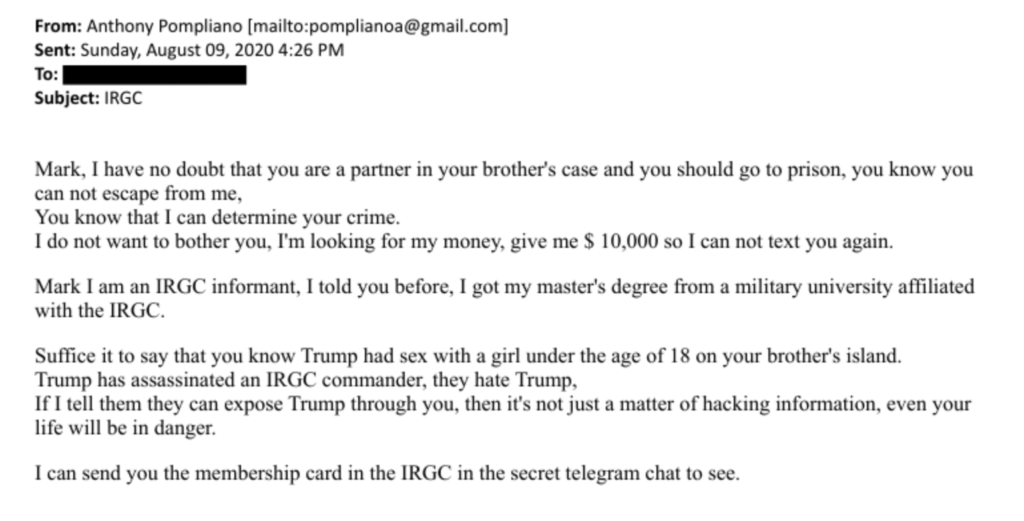
Strange, to say the least. Not sure we’ll ever get to the bottom of that one (Pomp himself has not acknowledged the emails and numerous folks on X have noted the email address does not tie back to Pomp).
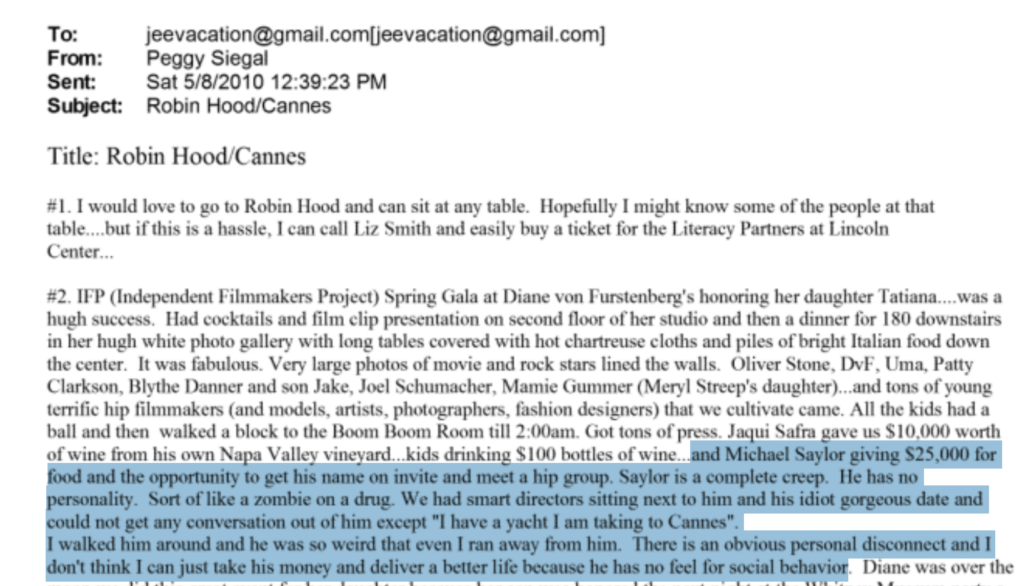
But the unexpected email that takes the cake involves none other than Michael Saylor, 10 years before his involvement in bitcoin. Publicist Peggy Siegal emailed Jeffrey Epstein about her interactions with Saylor, who sponsored a May 8, 2010 gala for independent film makers for $25,000.
Siegal penned some very unflattering words about Saylor, and rather than quote these, we’ll leave you with her take on Saylor in full, highlighted in the screenshot below.