“Perhaps the most enduring source of conflict within the Bitcoin community derives from incompatible visions of what Bitcoin is and should become.”
–Nic Carter & Hasu, Visions of Bitcoin
Bitcoin is very difficult to explain. Its purpose and place varies depending on who you ask. You will hear different explanations at a local Bitcoin meetup than you will in a corporate boardroom
In my opinion, the only way to really define what Bitcoin is is to run the code, but to explain what Bitcoin is is an ontological exercise.
I like to say “Bitcoin is what it is used for.” That’s not very useful, but we have 16+ years of Bitcoin history to sift through that might be more useful to define Bitcoin.
How should we model Bitcoin?
Nic Carter and Hasu wrote a fantastic piece titled Visions of Bitcoin in 2018, which categorizes different visions about Bitcoin’s essence and purpose. They ranked different narratives for Bitcoin according to popularity over time.
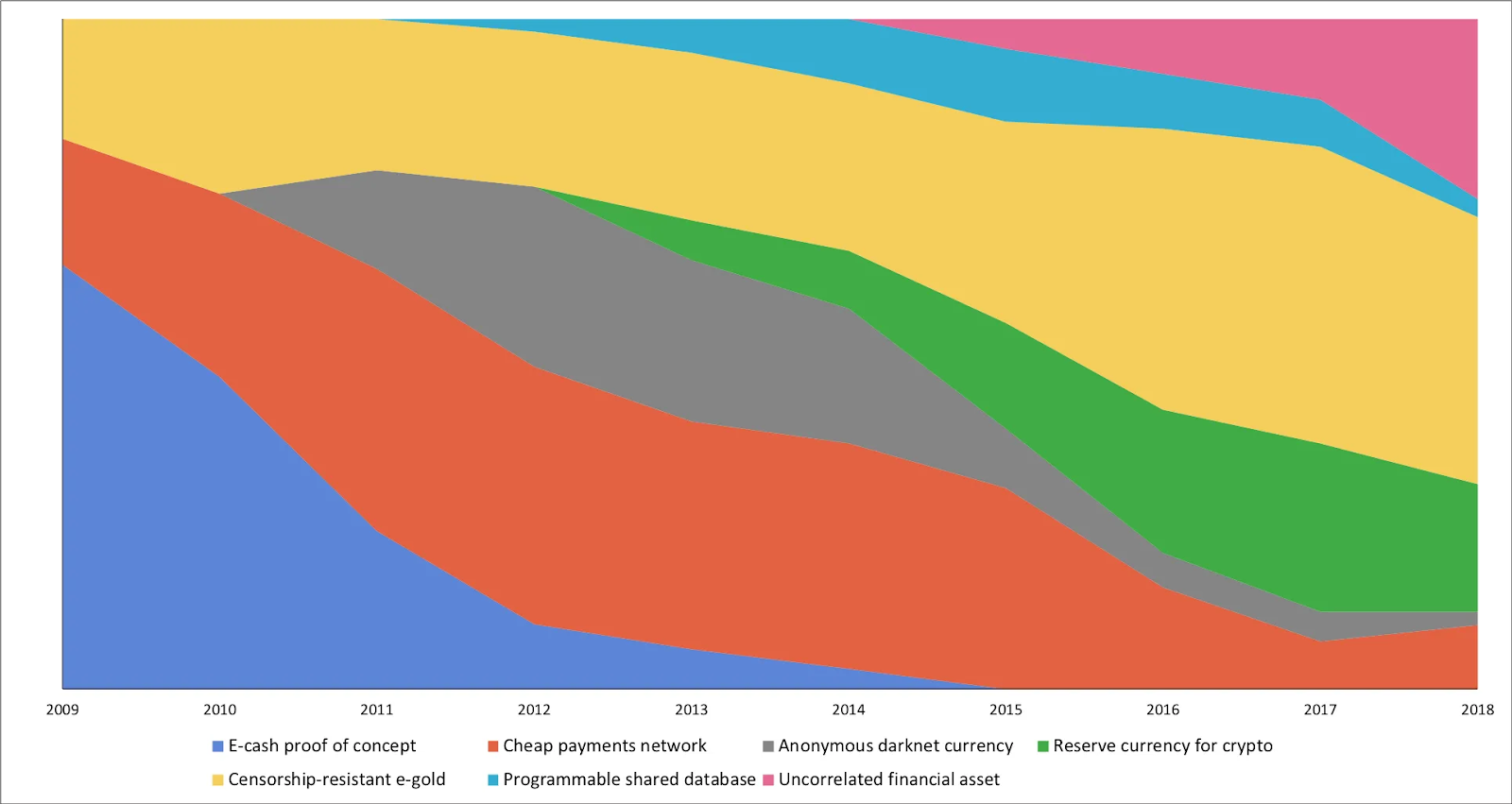
I consider this one of the most useful mental models for examining how to think about Bitcoin as a system of stakeholders, but the piece is now 7 years old and a lot has happened since. I’ve updated the chart and also added new narrative buckets.
Here’s my updated chart:
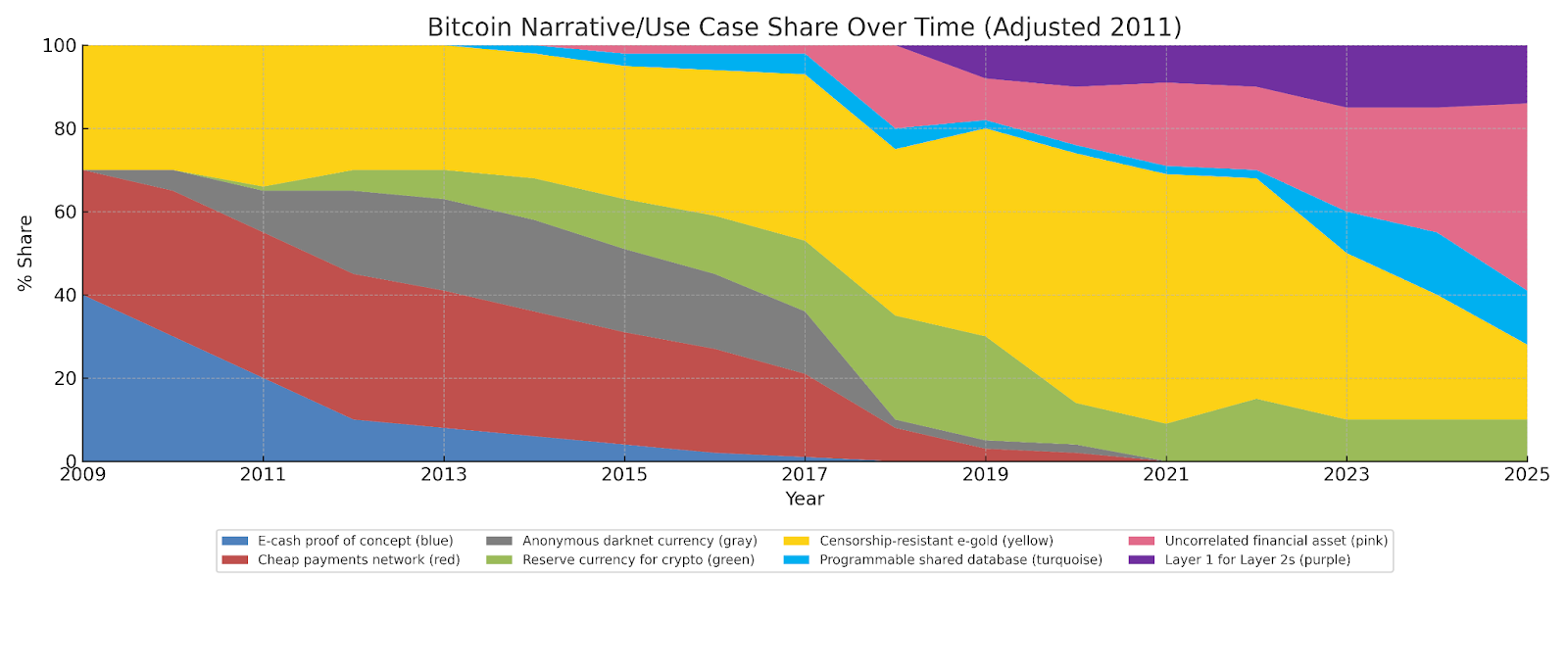
Bitcoin’s narratives
Now, let’s break down what each category means, and how these narratives have shifted since 2018.
Note: All below quotes are excerpts from Visions of Bitcoin.
Censorship‑resistant digital gold (yellow): “…the view that Bitcoin primarily represents an untamperable, uninflatable, largely unseizable, intergenerational wealth store which cannot be interfered with by banks or the State. Proponents of this view de-emphasize Bitcoin’s use for everyday transactions, arguing that security, predictability, and conservatism in development are more important.” I consider this the prevailing narrative of the modern era of Bitcoin Maximalism – the “Bitcoin is f*ck you money” crowd. At the time Carter and Hasu lumped “sound money” into this bucket, but I believe there is now a split in the sound money crowd between those who view Bitcoin as censorship-resistant digital gold or as an uncorrelated financial asset.
Reserve currency for crypto (green): “This is the view that Bitcoin serves an essential purpose as the native currency for the cryptocurrency/cryptoasset industry more generally. This is a view espoused by traders for whom BTC is the numeraire — the currency in which the prices of other assets are quoted.”
Not much has changed on this front since Carter and Hasu wrote their article. Crypto companies tend to store wealth in bitcoin, and bitcoin is the unit of account for the wider crypto markets
Uncorrelated financial asset / “pristine” financial asset (pink): “This is a view of Bitcoin that treats it strictly like a financial asset and finds its most important feature to be its return distribution. In particular, its tendency to have a low or nonexistent correlation to all manner of indexes, currencies, or commodities makes it an attractive portfolio diversifier. Proponents of the view are generally not too concerned about owning spot Bitcoin; they are interested in exposure to the asset. They want to buy Bitcoin-flavored risk, not necessarily Bitcoin itself.” This is the rising and currently dominant narrative of Bitcoin today. Saylor made his first smash buy two years after “Visions of Bitcoin” was published and he is now undisputedly the most important & influential person in Bitcoin. This is the “Paper Bitcoin Summer” bull market thesis.
Cheap payments network (red): “A straightforward currency for peer to peer internet transactions on-chain. A decentralized Paypal or Venmo, if you will. Proponents of this view generally believe that low fees and convenience are an essential characteristic of such a currency.”
This camp mostly split off into Bitcoin Cash during the Blocksize Debate. While you might think Lightning would go here, the context under which the authors defined this bucket was “on-chain” transactions in light of the Blocksize Debate. Today, virtually nobody still believes Bitcoin L1 is for cheap payments long term, although when fees spike or ordinals outbid some users it may cause an outcry of “you’re harming the Global South,” but those typically technically ignorant users appear to hold incompatible views of Bitcoin.. I have trouble figuring out where payments focused scaling technologies should go, so I am bucketing them in “Layer 1 for Layer 2s.”
Programmable and shared database (turquoise): Bitcoin can embed arbitrary data, not just currency transactions, so Bitcoin is an expressive protocol which can facilitate broader use-cases.
“In 2015–16, it was popular to express the notion that Bitcoin would eventually absorb a diverse set of functionalities through sidechains. Projects like Namecoin, Blockstack, DeOS, Rootstock, and some of the timestamping services rely on this view of the protocol.”
Ordinals kicked off a new era of this narrative – Bitcoin now immortalizes your jpegs, your arbitrary data. This bucket also includes indexer-based metaprotocols such as BRC20, Alkanes, and Runes. These are systems that post operations and instructions to Bitcoin and execute off-chain. I distinguish this from a rollup which posts data to Bitcoin but does not necessarily include all of the instructions/operations. It can be difficult to clearly define all rollups or systems such as Arch into this vs Layer 1 for Layer 2s at this time.
Anonymous darknet currency (gray): The view that Bitcoin is useful for anonymous online transactions, in particular to facilitate black market online commerce. This is not necessarily mutually exclusive with the e-gold position, as many proponents of the digital gold view believe that fungibility and privacy are important attributes. This was a popular narrative before the chain analysis companies had success de-anonymizing Bitcoin users. There are still a handful of darknet, privacy-type advocates for Bitcoin; but outside of a few developers, most users have moved onto other projects.
E‑cash proof of concept (blue): Bitcoin’s first major narrative and the general view of Bitcoin in its earliest days. Will Bitcoin work at all? (this category not to be confused with eCash/chaumian mints)
Layer 1 for Layer 2s: The view that Bitcoin serves as a “base layer” for securing or anchoring various Bitcoin layers. I use a very broad definition of what a Bitcoin “Layer” is so this is kind of a catchall term for the wide variety of scaling/expressivity layers including-but-not-limited-to: Lightning, Rollups, Ark, Sidechains (e.g., Liquid), ecash/cashu, statechains (Lightspark), Stacks, etc.
Ideological competition in Bitcoin
“Visions of Bitcoin” observed that certain narratives were directly incompatible. The authors, for instance, assert that the censorship resistant digital gold and cheap payments narratives were fundamentally at odds. What’s interesting is that I today struggle to identify how any of these narratives directly compete for how Bitcoin functions today.
For example, pristine financial asset users create virtually no transaction demand while programmable shared database + Layer 1 for Layer 2s are positioned to create most of the blockspace demand. These two use cases are actually almost perfectly compatible from a blockspace availability perspective.
However, we may see these narratives clash in the event of a soft fork. Covenant-enabling proposals such as OP_CTV/CSFS and OP_CAT are clearly favored by the Layer 2s and shared database camps, while the pristine asset and censorship-resistant digital gold groups generally say “don’t change anything”.
Decline of contemporary Bitcoin Maximalism
My final takeaway is that contemporary Bitcoin maximalism is no longer in the driver’s seat, or at least it’s evolving. “Bitcoin is f*ck you money” is no longer the largest onboarding call to action.
The world of financialized Bitcoin is upon us – it commands most of the attention. The voices of the self-custody maxis, the privacy advocates, the noncompliant Bitcoiners are drowned out by the cacophony of the stampeding herd of Bitcoiners in suits (“suitcoiners”). I place some blame on the Purity Spiral of Bitcoin maximalism that emerged around COVID, but then again the corporations were always eventually going to figure out an infinite money glitch by playing tradfi games.
Overall, the Bitcoin experiment has gone pretty well so far and we may be entering Eternal September. While it can be agonizing to feel like we’re always arguing about Bitcoin, I fear groupthink even more. Vires in numeris