

At first glance, you might think that bitcoin miners would gravitate toward regions with the lowest cost of power. The real equation, though, is more complicated than that, so that’s why the team at Hashlabs wrote our latest report, The Bitcoin Mining Ease to Mine Index, to explore which countries are the best (and worst) to mine bitcoin.
Download the full report to see where each country falls!
The Ease to Mine Index is the most comprehensive research of country level attractiveness for deploying and scaling bitcoin mining operations. The index captures a holistic view of the bitcoin mining regulatory environment and operating conditions across 18 countries.
Although Bitcoin mining is inherently location-agnostic, its global expansion has revealed major differences between jurisdictions. Not all countries offer the same regulatory clarity, fiscal incentives, energy access, permitting framework, tariff exposure, or operating conditions.
This index aims at bringing transparency to these disparities and bridge the knowledge gap about which countries are best to sustainably deploy bitcoin miners.
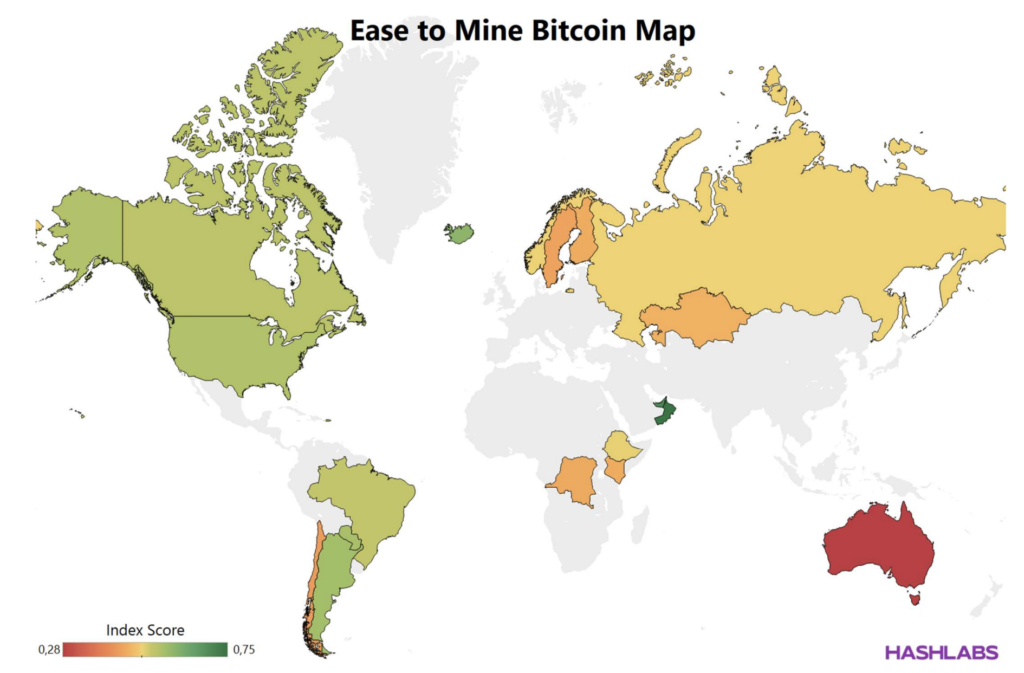
The index is based on a survey of 48 industry participants across 18 jurisdictions. Each country’s score reflects the relative ease of operating mining infrastructure according to several core factors, including legal and fiscal frameworks, permitting and licensing requirements, energy market structure and grid access, and tariffs and customs procedures. The index also factors in climate-related operating conditions based on internal analysis.
A country offering neutral mining conditions typically scores around 0.50, favorable environments generally achieve 0.60 or higher, and unfavorable jurisdictions tend to score at 0.40 or below.
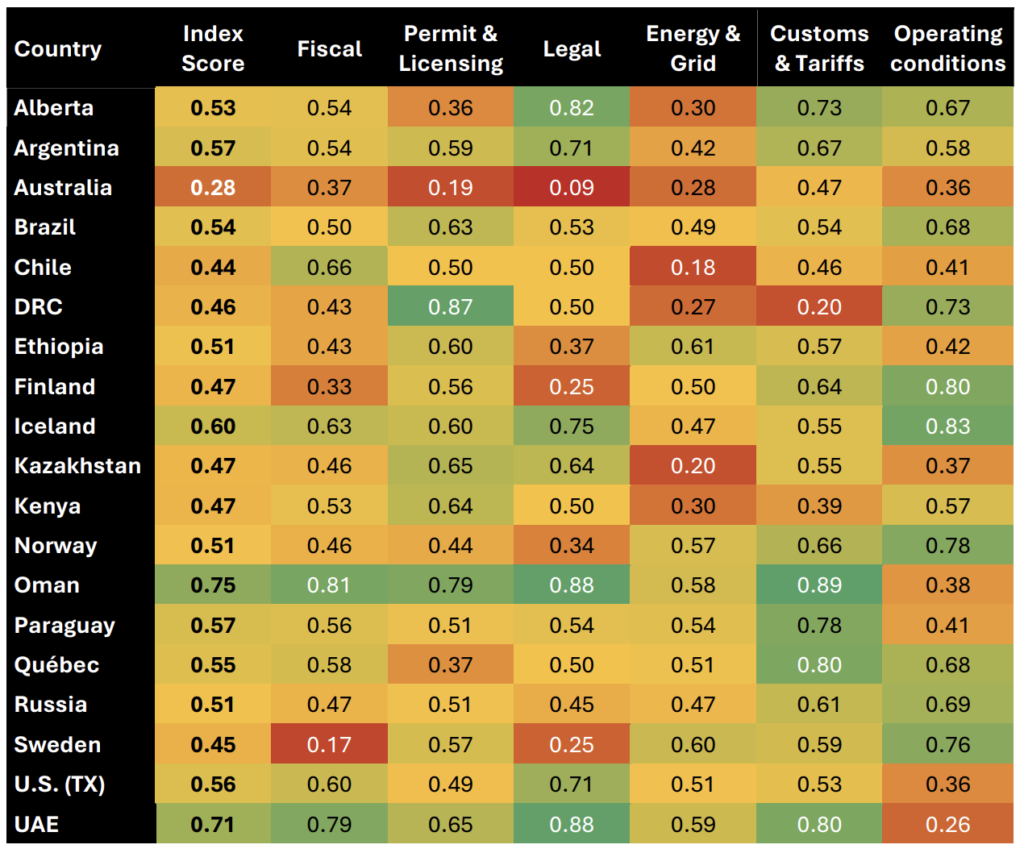
Importantly, a country’s overall score rarely tells the full story. Examining each component often reveals more meaningful insights than looking solely at the aggregate ranking.
For example, some may be surprised that the United States (using Texas as a proxy) scores 0.56, while Oman reaches 0.75. This difference largely reflects Oman’s highly favorable legal, fiscal framework and permissive permitting regime, which create conditions that make the country stand out as a bitcoin mining El Dorado. By contrast, U.S. miners increasingly face tightening power markets due to AI/HPC competition, elevated tariffs, and stricter zoning regulations for data center construction and operation.
Capturing this granularity and nuance is the backbone of the report’s methodology. As public bitcoin miners are shifting toward AI/HPC, bitcoin mining trends could become more opaque in the short term and less concentrated (geographically and operationally).
There is no mass exodus from the U.S. historical mining hub yet. Instead, the phased shutdown of legacy mining hardware is acting as a catalyst for the industry’s ongoing global expansion.