
Block (NYSE: XYZ, formerly Square), a U.S.–based financial technology company founded in 2009 by Jack Dorsey and Jim McKelvey, has made Bitcoin a core part of its strategy. Most recently, Block’s bitcoin miner manufacturing division, Proto, released its flagship ASIC miner, Rig, at a launch in Dalton, Georgia last week. “It’s been a long time coming. When people asked what we were up to, this was it,” Block’s Perry Hothi said on a recent Mining Pod.
Perry Hothi is a blockchain solutions architect at Block and a lead contributor to the Proto project. At Proto, he has focused on designing modular mining rigs and open-source software to improve fleet management, upgrade costs, and uptime for operators.
The following is an edited summary of a recent Mining Pod interview with Block’s Perry Hothi. In this episode, Hothi discusses the launch of Block’s new Bitcoin mining unit, covering the miner’s technical design and modular hardware, supply chain challenges, and how Proto fits into Block’s larger Bitcoin ecosystem.
Welcome back to the Mining Pod. It’s been about eight months since you were last on. At that time you announced the ASIC chip in Dallas. Now, you’ve just launched the new unit. Congrats to you and the team.
It’s been a long time coming. When people asked what we were up to, this was it. Building something different from everyone else takes longer. We wanted to get it right—looking not just at the miner itself, but the facilities, infrastructure, financing, and input from across departments. Even ops teams had input. A simple but important change was removing fans on the back. Once people stepped into a hot aisle and realized how much easier it is without those fans, it clicked.
Let’s go through some specs. I think you’re at 14.1 joules per terahash on the low end. Correct me if I’m wrong, but the average might be slightly higher in production?
Yes and no—there’s nuance. Competitors like Bitmain usually release multiple models for the same generation, like Pro or XP versions. We designed one chassis with modular options. Everyone has different power costs and financing needs, so we offer different configurations. It’s not just about efficiency and price—it’s about profitability. For some, a cheaper, less efficient unit might make more sense depending on their power contracts or financing.
So you’re looking at profitability in a broader sense, not just specs on paper.
Exactly. It depends whether someone is holding the Bitcoin they mine, how they finance equipment, and their power terms. Our team includes people with finance backgrounds, so we can help model what makes sense. The 14.1 J/TH is a real number, not a cherry-picked low sample, but not everyone will need to run at that. The goal is to optimize for IRR or payback period, not just efficiency.
And the unit runs around 800–810 TH/s, correct? Any other specs worth noting?
Yes, 810 TH/s. The chassis is the same height and width as two S21s, so it fits existing racks and airflow systems. It draws about 12 kW. One unique design is how we handle three-phase power. Normally miners consume single-phase power, which can lead to imbalance. We built in three power supplies, one per phase, so facilities can use all their power more efficiently. If a board goes down in one bay, the others can scale up or down to keep overall consumption balanced. At scale—tens of thousands of miners—that matters a lot.
One part that caught attention today is the software. Some people framed it as going after third-party management tools. Is that fair?
Our goal isn’t to compete with anyone. It’s to help. We visited facilities still using basic tools and spreadsheets to track miners, which is inefficient. So we built software that anyone can download and use. It’s open source, and we hope others contribute features. For us it’s about improving uptime, insights, and ease of management for miners of any size. We’re not charging for it because we want to give back to the mining community.
You also designed this with modular hash boards. That’s closer to how data centers think. What was the thinking there?
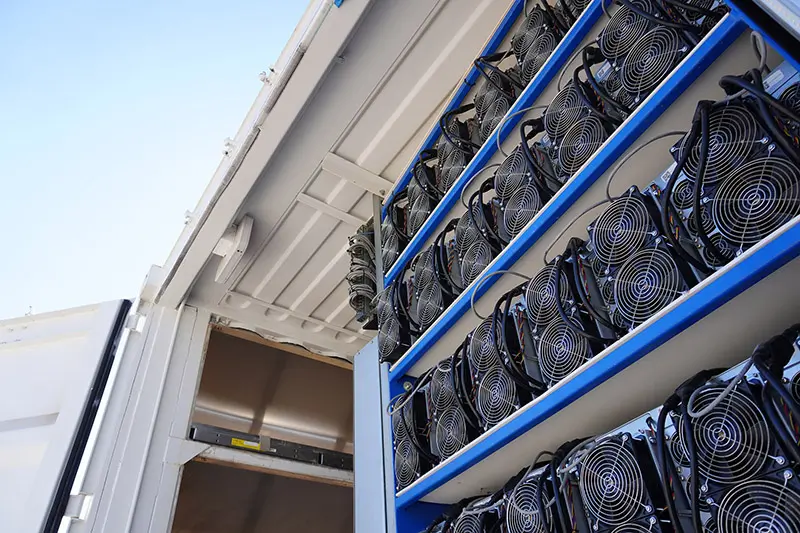
Fans are the most common failure point. Our design uses fewer but higher-quality fans, reducing failures. For every three hash boards, there are two fans—versus seven in a shoebox design. Power supplies also use fewer fans. The idea is simple: the best repair is no repair. If you don’t need to take a machine off the rack to replace fans, you improve uptime and profitability. Shipping is also simpler—operators don’t need to move entire chassis across the world, saving money and waste.
So less waste and lower logistics costs.
Exactly. Shipping heavy chassis, paying tariffs and taxes, and dealing with packaging all adds up. With modular boards you avoid that. Even the packaging design matters—we thought about how miners actually carry and handle these units. We don’t want operators hurting their backs or damaging grills just moving them around.
Do you know the ASIC count and chip frequency off the top of your head?
It varies depending on configuration, anywhere from about 96 to 120 chips. Frequency can range from 300 MHz to over 600–700 MHz. We don’t like to think of it as overclocking or underclocking—just an operating range. You’re limited by the power supply and thermals, and customers can tune within that.
Let’s zoom out from the specs. How does this miner fit into Block’s broader Bitcoin strategy?
We believe in Bitcoin. Cash App helps people access it, terminals bring in payments, hardware wallets make storage safer. Miners secure the network. We wanted to address every part of the ecosystem, and mining was the most difficult. It’s capital-intensive, making chips and firmware is not easy, and it takes time. But we felt it was important to tackle it.
Bitmain controls 80% of the market. How do you see yourselves competing?
We’ll let our work speak for itself. No one sets out to be second place. Competitors have a head start, but this launch shows what we can do. The response has been positive. We don’t expect to leapfrog Bitmain overnight, but hopefully it pushes the whole industry to innovate faster.
Competitors are approaching sub-10 joules per hash. Will you release higher efficiency units in the future?
Yes. Future generations will be more efficient. But we’re equally focused on building a strong supply chain. It’s not enough to design a good miner—you need to deliver it reliably worldwide. We’ve set up logistics across regions, and we’re working toward producing more components locally, potentially in the U.S. Even packaging has been carefully thought through. From the way boards slide into place to how units are handled, we want every detail right.
Any hidden easter eggs in the unit?
Not that I know of, but if people find any, let me know. Maybe something for future versions.
Read More: