
Earlier this month, investment bank Jefferies made headlines announcing the reduction of its exposure to bitcoin due to perceived quantum computing risk.
Pundits on the issue made several victory laps, noting that capital allocators indeed care about the potentially fatal risk to bitcoin.
However, while some investors may be reallocating, I would push back on the claim that this is currently a broad trend.
Moreover, when I see a claim like Charles Capriole’s “Quantum Discount,” I have reason to suspect some (not all) are manufacturing a narrative.
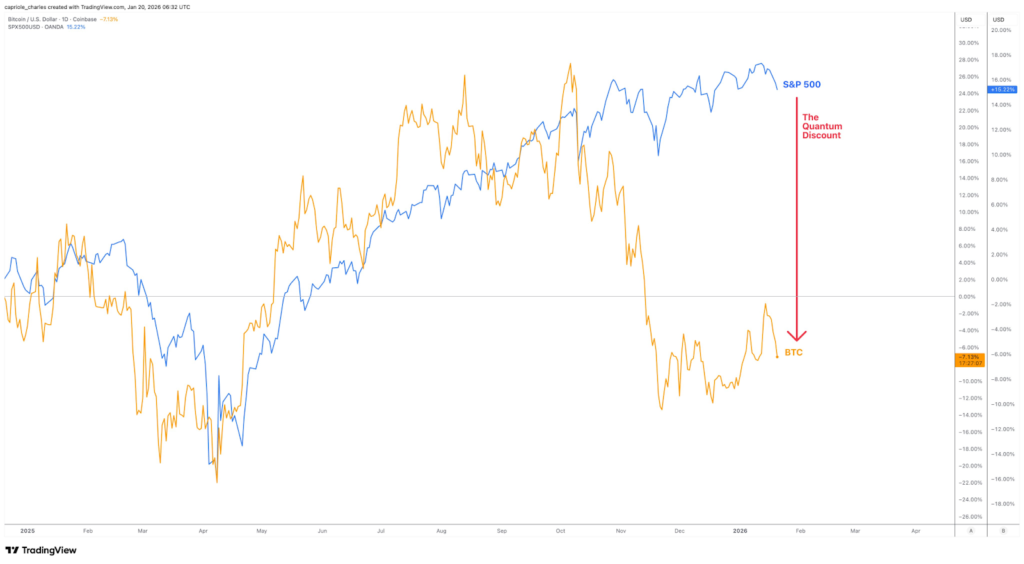
I do believe that investors have started scoping the risk, but outside of a few anecdotes and the Jefferies headline, I strongly doubt that this has had any effect on confidence in bitcoin . . . yet.
As I see it, the argument is as follows:
- If investors were pricing quantum risk correctly, they would need deep technical understanding or close communication with experts who do.
- Deep technical understanding would lead to accurate pricing of other technical risks to Bitcoin.
- I do not believe those other technical risks are accurately priced in. I would wager most investors are unaware of them.
- Therefore, quantum risk is likely not accurately priced in either.
To be clear: it’s fair to criticize perceived nonchalance from leading Bitcoin developer voices. Further, investors should take quantum risk seriously and selling bitcoin is the logical way for inventors to derisk from quantum computing exposure.
I’m just not convinced that they’re selling today.
Bitcoin’s quantum computing risk is just one of many
Quantum computing may come sooner rather than later. I’m currently agnostic on timeline.
Like venture capitalist Nic Carter, I too have done a lot of legwork over the past year to understand the subject. It’s incredibly complicated.
To be familiar enough with the technical risk quantum poses to bitcoin, investors would need to be extremely sophisticated. If they understand quantum computing risk, they would necessarily understand other, less arcane risks to Bitcoin that are absolutely possible today.
There are even financial incentives to execute some of these attacks on Bitcoin. The most crippling one, a poison block attack, didn’t even have anyone monitoring. Perhaps this was due to complacency or, quite frankly, denial that anyone would attempt one. (A “poison block” is a block that basically makes it impossible for other block producers to validate your block in any reasonable timeframe; you can learn more about it in this talk from last year’s OPNEXT).
The omnibus Great Consensus Cleanup proposal that would mitigate a few of these attacks has been sidelined for half a decade, only recently having been picked back up.
Were these investors (who are supposedly so attuned to the indecipherable nuances of lattice-based cryptography & physical qubit construction so as) selling Bitcoin in 2024? At the time severe risks to Bitcoin had been known and solutions sidelined for half a decade because nobody really wanted to have to do the tedious work to fix them.
I would be surprised if many of these investors even know about these risks, as I never hear them discussed by the cohort. In my opinion, they may be as existential to Bitcoin as quantum computing.
But don’t take my word for it. Hunter Beast, the co-author of the leading quantum fix proposal, BIP-360,says that he is “more worried about the danger of poison blocks right now” than quantum computing. (To be clear, Hunter also says investors are concerned about quantum).
In essence, a poison block attack could not only be profitable for the attacker, but it could also feasibly cause a scenario where Bitcoin would be incentivized to coordinate a chain rewind.
Does that break the “immutability” value thesis of Bitcoin for investors?
And this is just one such attack. How many investors are familiar with the timewarp attack? Do they question why such an attack hasn’t happened yet? Are they familiar with the more recently identified “Murch-Zawy” timewarp attack?
Are investors aware that “51% attack” is really just normie slop? The real threshold for this attack is around 30%, which a single entity likely already possesses.
Have investors priced that in? What about the potential for duplicate transactions, or compiler backdoors? The list goes on.
Quantum computing risk is not why bitcoin is down right now
We are approaching 20 years of Bitcoin and in Satoshi’s words “I’m sure that in 20 years there will either be very large transaction volume or no volume.” We are 17 years in and fees are the lowest they’ve been. To some, it’s even quite heretical to point this out as a concern.
The sad, boring truth is that Bitcoin is down today because it’s just not the trade du jour right now. As Checkmatey says “attributing price being down to [quantum computing risk] as a primary factor, is akin to blaming market manipulation for red candles, and declining exchange balances for green ones.”
I’m certain that, as the quantum computing topic heats up, investors will react and derisk. Perhaps it will be their first informed derisking event for Bitcoin – a mulligan for the previous 17 years of inaction.
Header image by RuinDig/Yuki Uchida.