


TeraWulf (NASDAQ: WULF) released its full-year 2025 earnings on Thursday, reporting $168.5 million in revenue, up 20% from $140.1 million in 2024. The annual results included the company’s first full year of HPC lease revenue, which contributed $16.9 million to the total.
TeraWulf posted a net loss of $661.4 million for the year, compared to a net loss of $72.4 million in 2024, driven largely by a $429.8 million swing in the fair value of warrant and derivative liabilities. Non-GAAP adjusted EBITDA came in at negative $23.1 million, compared to positive $60.4 million the prior year.
The #1 podcast for emerging tech stocks, Bitcoin, and weekly news analysis. Subscribe to the Blockspace Podcast here, on Apple, Spotify, or anywhere you listen to podcasts.
For the fourth quarter, TeraWulf generated $26.1 million in bitcoin mining revenue, down from $43.4 million in the third quarter, reflecting lower bitcoin production and a weaker bitcoin price. Conversely, HPC lease revenue rose to $9.7 million in Q4 from $7.2 million the prior quarter.
TeraWulf ended the year with $3.7 billion in cash, cash equivalents, and restricted cash, a sharp increase from $274.1 million at the close of 2024. The jump reflects $3.1 billion in proceeds from long-term debt issuances and $1.97 billion from convertible notes raised during the year.
On the construction front, TeraWulf’s Lake Mariner campus in New York has 39 critical IT MW of HPC capacity online. Additional buildings are on schedule, with CB2B targeted for March 2026, CB3 for mid-May 2026, CB4 for Q3 2026, and CB5 for Q4 2026. TeraWulf said that its design optimization for buildings CB4 and CB5 increased total capacity from 162 MW to 168 MW per building without adding to its construction budget.
“These projects reflect disciplined construction execution and close coordination with our hyperscale stakeholder and customers,” Chief Technology Officer Nazar Khan said in the press release. “Our teams are advancing build schedules, integrating tenant fit-out requirements, and optimizing cooling, electrical, and design architecture to support next-generation AI workloads at scale.”
TeraWulf has signed long-term lease agreements totaling 522 critical IT MW, representing over $12.8 billion in contracted revenue. That figure includes 60 critical IT MW leased to Core42 at Lake Mariner and 380 critical IT MW leased to Fluidstack, with the latter deal backstopped by Google.
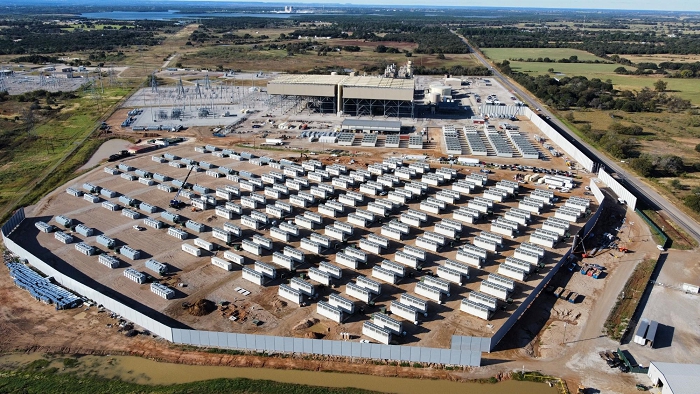
In October 2025, TeraWulf entered a joint venture with Fluidstack to develop the Abernathy HPC Campus in Texas. The 168 critical IT MW campus carries a 25-year lease with annual escalators and is backed by Google, with delivery targeted for the second half of 2026.
Chief Executive Paul Prager addressed the company’s forward outlook in the 2025 earnings press release.
“We enter 2026 with 522 critical IT MW of contracted HPC capacity and a gross 2.9-GW multi-regional platform designed for long-term expansion,” Prager said. “Our focus remains on disciplined execution, transparent capital allocation, and converting energy-advantaged infrastructure into durable, long-term cash flow.”
Following year-end, TeraWulf expects to add sites in Kentucky and Maryland, bringing total platform capacity to approximately 2.9 gigawatts across five locations. The multi-year development pipeline targets delivery of 250 to 500 critical IT MW annually through the end of the decade.